Rule of 20: When to Open Light in Bridge
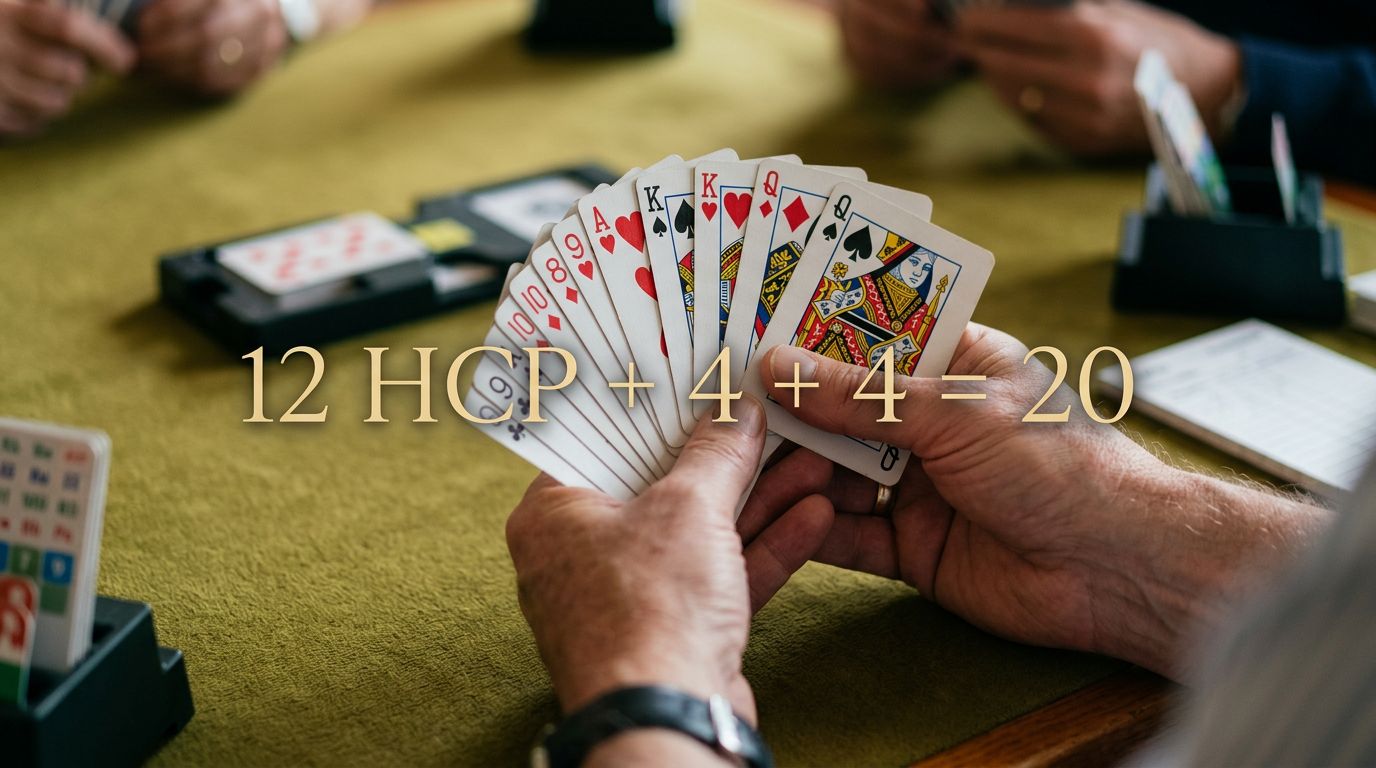
You pick up this hand in first seat:
♠ KQ54
♥ A873
♦ 6
♣ K1064
Count your high-card points. You’ve got 12. Traditionally, that’s a pass, you need 13 to open, right?
But hang on. Look at the shape. Two four-card majors, a singleton, good spot cards. This hand has offensive potential written all over it. Are you really going to pass and potentially miss game, or worse, let opponents steal the auction when you have a perfectly good opening bid?
Enter the Rule of 20, popularized by American expert Marty Bergen in the 1990s. It’s a simple guideline that helps you decide whether borderline hands are worth an opening bid, and it captures something important that raw point count misses: distribution matters.
What Is the Rule of 20?
The Rule of 20 is dead simple:
Add your high-card points (HCP) to the length of your two longest suits. If the total is 20 or more, open the bidding.
That’s it. No complicated calculations. Just three numbers added together.
For the hand above:
- 12 HCP (K=3, Q=2, A=4, K=3)
- 4 spades (longest suit)
- 4 hearts (second-longest suit)
- Total: 12 + 4 + 4 = 20
Open 1♣. Done.
The Rule of 20 is designed for first or second seat (when partner hasn’t passed yet). In third seat you might open lighter for tactical reasons. In fourth seat, consider the Rule of 15 or Pearson Points instead.
Why It Works
Traditional point count, 4 for an ace, 3 for a king, 2 for a queen, 1 for a jack, was invented nearly a century ago by Milton Work. It’s brilliant for its simplicity, but it treats all 13-point hands the same.
They’re not.
A flat 4-3-3-3 hand with 13 HCP has limited trick-taking potential. A shapely 5-4-3-1 hand with 11 HCP can generate extra tricks through ruffs, long-suit establishment, and better communication with partner.
The Rule of 20 adjusts for this reality. It rewards:
- Long suits that can establish tricks
- Distribution that creates ruffing potential
- Two-suited hands with flexible bidding options
And it penalizes flat, aceless collections of queens and jacks that look pretty on paper but don’t pull their weight at the table.
Examples
Let’s try a few hands to see how the Rule of 20 works in practice.
Example 1: Classic Rule of 20 Opening
♠ AQJ865
♥ —
♦ 972
♣ K754
- 10 HCP (A=4, Q=2, J=1, K=3)
- 6 spades + 4 clubs = 10 cards
- Total: 10 + 6 + 4 = 20
Verdict: Open 1♠
Only 10 HCP, but that six-card spade suit with void in hearts has massive offensive potential. This hand will likely take more tricks than many balanced 13-counts. Open it.
Example 2: The Hand Everyone Passed
♠ KQ54
♥ A873
♦ 6
♣ K1064
- 12 HCP (K=3, Q=2, A=4, K=3)
- 4 spades + 4 hearts = 8 cards
- Total: 12 + 4 + 4 = 20
Verdict: Open 1♣
This is the hand from Marty Bergen’s famous class where 27 out of 28 students passed. They counted 12 points and stopped thinking. The Rule of 20 says open, and it’s right. Two four-card majors, a singleton, concentrated honors. This hand wants to bid.
Example 3: Shapely but Not Quite
♠ KJ5
♥ A875
♦ Q75
♣ Q62
- 12 HCP (K=3, J=1, A=4, Q=2, Q=2)
- 4 hearts + 3 spades = 7 cards
- Total: 12 + 4 + 3 = 19
Verdict: Pass
Balanced hands with fewer than 13 HCP almost never satisfy the Rule of 20. That’s fine, they shouldn’t open. This hand has no source of tricks, no distributional advantage, just scattered honor cards. Save your opening bid for something with more potential.
Example 4: Seven-Card Suit Magic
♠ 87
♥ Q54
♦ AKQ9764
♣ 9
- 11 HCP (A=4, K=3, Q=2, Q=2)
- 7 diamonds + 3 hearts = 10 cards
- Total: 11 + 7 + 3 = 21
Verdict: Open 1♦
A seven-card suit is gold. This hand will take tricks. Even with only 11 HCP, the long diamond suit gives you an excellent opening bid. Your diamonds are self-sufficient and you have good intermediates (9-7-6-4). Open with confidence.
Example 5: When Suits Tie
♠ T8
♥ KT973
♦ 6
♣ AK865
- 10 HCP (K=3, T=0, A=4, K=3)
- 5 hearts + 5 clubs = 10 cards
- Total: 10 + 5 + 5 = 20
Verdict: Open 1♥
When you have two five-card suits (or any tie for longest/second-longest), pick either one for your calculation—preferably a major suit. This hand hits exactly 20 and has two five-card suits. Perfect opening bid material. Open 1♥ and plan to show clubs later.
When to Adjust the Rule
The Rule of 20 is a guideline, not gospel. Expert players use it as a starting point, then adjust for hand quality. Here are factors that make borderline hands better or worse:
Upgrade These Hands (Open with 19)
- Strong spot cards: Tens and nines add trick-taking potential
- Concentrated honors: AQT75 is better than scattered queens
- Good suit quality: AQJxx beats KQxxx
- Favorable vulnerability: Not vulnerable? Be more aggressive
Downgrade These Hands (Pass with 20)
- Aceless hands: Hands without aces often disappoint
- Flat shape with minimum HCP: 4-4-3-2 with 11 HCP barely scrapes 20
- Short honors: Singleton kings, doubleton QJ are overvalued
- Quacks: Queens and jacks without aces or length
- Values outside long suits: AQ in doubleton clubs doesn’t help your six-card spade suit
Larry Cohen, another bridge expert, notes: “The Rule of 20 is a good basic starting point, but can use some fine-tuning.” He’s right. If your 20 consists of 11 HCP with ♠Qxxx ♥Jxxx ♦KQ ♣Axx, you might want to pass. If it’s 11 HCP with ♠AQT75 ♥AT965 ♦43 ♣2, you’re opening all day.
Common Mistakes
Mistake #1: Using It in All Seats
The Rule of 20 is specifically for first and second seat. In third seat, you might open lighter for tactical reasons (protecting partner who already passed). In fourth seat, different math applies, you’re the last chance to open, so the calculation changes.
Mistake #2: Opening Bad Balanced Hands
Just because a balanced hand hits 20 doesn’t mean it’s worth opening. A flat 4-3-3-3 hand with 12 HCP adds up to 19 or 20, but it’s still a dog. The Rule rewards distribution, if you have none, be conservative.
Mistake #3: Ignoring Hand Quality
Two hands can both total 20 with wildly different trick-taking potential:
Hand A:
♠ KQ54 ♥ A873 ♦ 6 ♣ K1064
(12 HCP + 4 + 4 = 20, quality honors, good shape)
Hand B:
♠ Jxxx ♥ Qxxx ♦ x ♣ KQxx
(11 HCP + 4 + 4 = 19, scattered quacks)
Hand A is a clear open. Hand B is borderline at best. Use judgment.
Mistake #4: Forgetting Partnership Style
If you and partner play sound openings, opening light hands can create rebid problems. If partner expects 13+ and you have 11, your second bid might box you in. Make sure your partnership style supports the Rule of 20.
Partnership Discussion
Before using the Rule of 20 with a new partner, discuss:
- Do we follow it? Not all players do. Some prefer traditional 13 HCP minimums.
- How strict are we? Do we upgrade/downgrade for hand quality?
- What about rebid problems? If I open 1♣ with 11 HCP, what’s my plan over partner’s 1♠ response?
- Vulnerability matters? Some pairs open lighter when not vulnerable.
The worst thing you can do is have mismatched expectations. If partner thinks you have 13+ and you have 11, their bidding will be too aggressive. Get on the same page.
Historical Context
Marty Bergen popularized the Rule of 20 in his book Points Schmoints! in the 1990s, though some credit earlier bridge writers with similar ideas. Bergen’s genius was making it simple and memorable.
Bergen taught bridge for over 20 years and noticed students were passing good hands because they counted only HCP. They’d pass 12-count two-suiters and then watch opponents make game. Or worse, they’d open flat 13-counts that went nowhere.
The Rule of 20 fixed that. It gave players a fast, reliable way to evaluate distributional hands without complex calculations. And it worked, players who adopted it got to open more hands, got the first punch in competitive auctions, and bid more accurately after opening.
The Bottom Line
The Rule of 20 isn’t perfect. It’s not a replacement for judgment. But it’s a damn good starting point.
If you’re a newer player, follow it strictly. It will improve your opening frequency and get you bidding shapely hands that deserve to be bid.
If you’re more experienced, use it as a baseline and adjust for hand quality. Tens, nines, suit quality, and controls all matter.
Most importantly: stop passing good distributional hands because you counted 12 points. Bridge is about tricks, not points. A shapely 11-count can make game. A flat 13-count might not make 1NT.
The Rule of 20 helps you tell the difference. Use it.
Want to practice hand evaluation? Try Brian, our AI bridge coach, and get instant feedback on opening bid decisions. Brian evaluates hands the way experts do, not just counting points, but considering shape, suit quality, and controls. Perfect for drilling the Rule of 20 in real-time.